

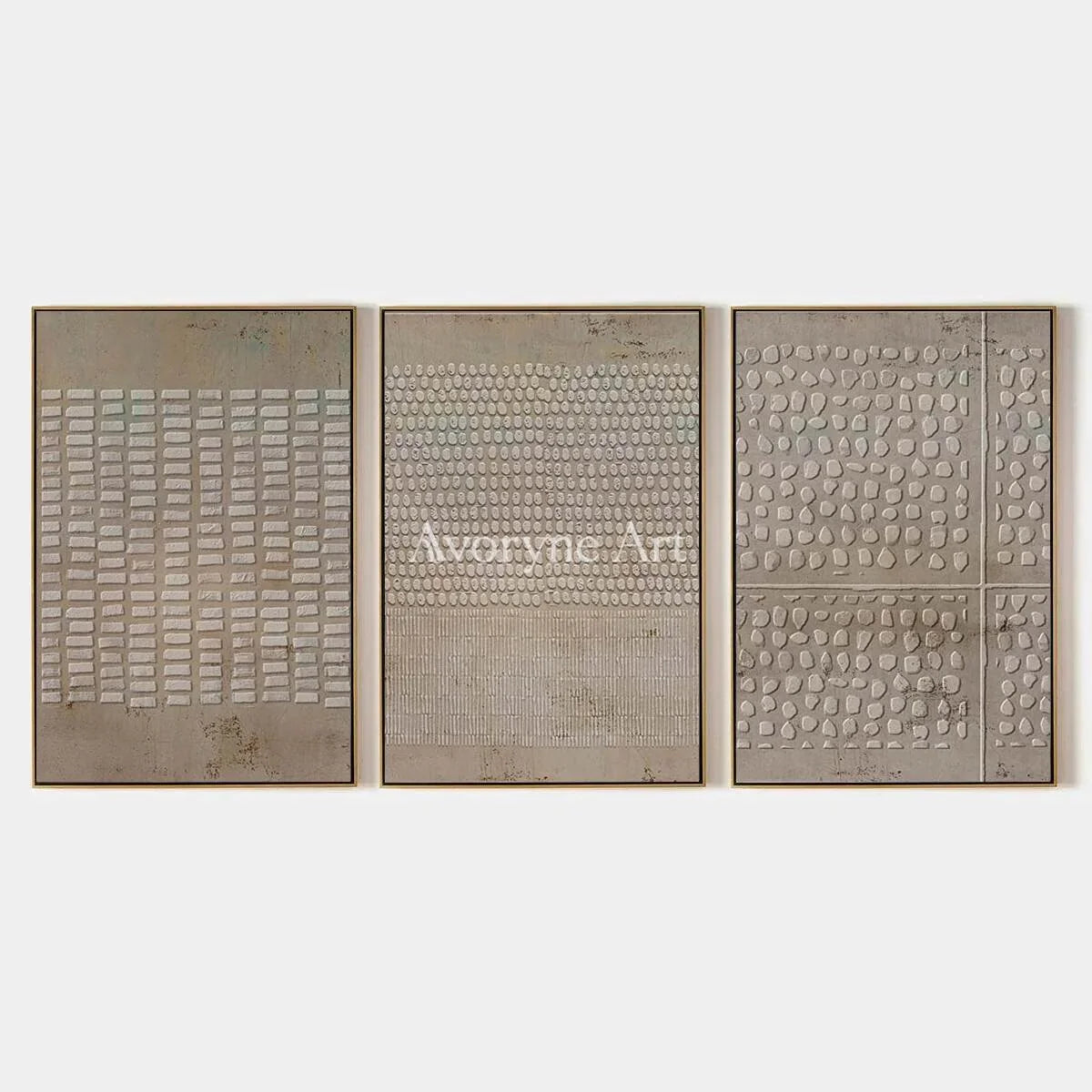
A diptych is a single artwork painted across two panels; a triptych spreads one composition across three. Both are hung as a group with small, even gaps between the panels, and both are measured by their total span, panels and gaps together, rather than by the size of one canvas.
Diptych or triptych: what is the difference?
The terms come from the hinged altarpieces of medieval Europe, where two or three painted wooden panels folded together. Today they describe any work designed to be read across separate canvases.
- Diptych (two panels). Two halves that answer each other: a line that crosses the gap, two related flowers, a horizon split in the middle. A pair reads calmly and suits shorter walls, a loveseat or the space above a bed.
- Triptych (three panels). A center with two sides. The middle panel often carries the main form while the outer panels extend it. Three panels cover a long wall and give a wide sofa or sideboard a clear focal point.
How to calculate the total width
Add the width of every panel, then add each gap. For three 16-inch-wide panels with 3-inch gaps: 16 + 16 + 16 + 3 + 3 = 54 inches. For two 24-inch panels with a 3-inch gap: 24 + 24 + 3 = 51 inches. If you choose a framed option, use the finished outside width of each framed panel.
Compare that total with the furniture beneath it. A common planning range is two-thirds to three-quarters of the furniture’s width; our sofa sizing guide has a full chart. Check the height too: three tall panels can span the right width but need more clear wall above the furniture.
Product pages describe multi-panel sizes in slightly different ways, for example “3P 48 × 20 in (each 16 × 20 in)” or “each 36 in H × 18 in W”. Read whether a figure describes each panel or the whole set before you compare it with your wall.
How far apart should the panels hang?
For most living-room arrangements, a gap of about 2–4 inches between panels keeps them reading as one artwork. Use the same gap between every panel; uneven spacing is the first thing the eye notices. Smaller panels look best with gaps at the lower end of that range; very large panels can take slightly more.
- Cut paper templates to the size of each panel and tape them to the wall.
- Set the gaps with a spacer block or a strip of card cut to your chosen width.
- Level the top or the center line across all panels, then mark the hanging points.
- Hang the middle panel first in a triptych, then work outward.
Each panel is fixed separately, so use hardware rated for its weight and your wall type, and confirm installation with your installer where needed.
Which layout suits which wall?
| Wall | Layout to compare |
|---|---|
| Above a three-seater sofa | Triptych of square or slightly tall panels, total span about two-thirds of the sofa |
| Loveseat or reading chair | Diptych of two smaller panels |
| Above a bed | Wide diptych or triptych kept inside the headboard width |
| Dining room or sideboard | Horizontal triptych centered on the table or cabinet |
| Hallway or staircase | Tall diptych panels, or panels hung in a vertical stack on a narrow wall |
| Office or lobby | Large triptych sized to the full seating or reception area |
Choosing a style across two or three panels
Multi-panel work exists in almost every style, and the panel split changes how each one reads.
- Textured and Wabi-Sabi. In Archive of Earth by Lin Qiao, three taupe plaster panels carry different raised patterns, so the set rewards a close look under side light.
- Minimalist. In Twofold Pause by Mei Arlen Zhao, bold black shapes continue from one cream panel to the next like a single gesture.
- Landscape and coastal. Faint Echo by Renji Aoki spreads a carved impasto mountain range across three tall panels; Estuary Rhythm by Rafael Duarte is a calmer aerial view of sand channels and tide pools sculpted in beige plaster.
- Cubist and figurative. Threefold Dialogue by Tomas Berger fills three teal, cream and black panels with interlocking cubist profiles, a mid-century graphic set.
- Black and white. Muted Field by Mei Arlen Zhao crosses a textured white ground with bold black brushstrokes, like large-scale calligraphy.
Browse every pair and set in sets of 2 and 3, or narrow by style in Wabi-Sabi, minimalist, landscape and abstract wall art.
Framing a multi-panel set
Each panel of an Avoryne Art diptych or triptych is painted by hand to order and finished separately. Options include rolled canvas, stretched and frameless, or stretched with a black, silver, white, wood or gold frame. Frameless panels give the cleanest, continuous look across the gaps; a frame adds a defined edge to each panel and slightly increases the total width. See rolled, stretched or framed canvas for the trade-offs.
Questions about diptych and triptych art
What is a diptych?
A diptych is a single artwork made of two panels designed to hang side by side. The composition usually continues or answers across the gap.
What is a triptych?
A triptych is an artwork made of three panels hung together, typically with a central panel flanked by two side panels.
How far apart should you hang a triptych?
About 2–4 inches between panels works for most rooms. Keep every gap the same, and include the gaps when you measure the total width.
Is a triptych better than one large painting?
Neither is better in itself. A triptych reaches a large overall width with smaller panels, which can be easier to ship and hang; a single canvas gives one uninterrupted surface.
What size triptych for above a couch?
Aim for a total span, panels and gaps included, of about two-thirds to three-quarters of the couch’s width: roughly 56–63 inches for an 84-inch sofa.
Can a diptych be hung vertically?
Yes. Stacking two horizontal panels one above the other can suit a narrow wall, a staircase or the space beside a doorway. Keep the gap equal to what you would use side by side.
Not sure which size fits? Send us your wall measurements and a photo of the room, and we can suggest panel sizes or paint a custom set.


Share:
How to Review Your Painting Before It Ships